Is wayland preferred over X11 in CachyOS? There have been instances that indicate the same.
Wayland seems to be popular among the forum members. I want to know the choice from the developers of this distro who have definitely preferred one over the other (Wayland vs X11) based on the merit of the technologies.
The motivation for my question is to align myself with the paradigm of the developers of the distro. I have no special love for either wayland or X11. I consider them as a tool to get the work done. I believe when in Rome, be a Roman. Hence, after knowing the answer here, I will stick to the CachyOS developers’ preferred display technology as and when I use CachyOS.
In the latest install ISO, in X11 the settings for touchpad is not being shown in KDE settings, but in wayland it is.
The team proactively changed the SDDM to start with Wayland before the rest of the Arch ecosystem.
Correct me if I am wrong, general software support for wayland lags behind X11 till date.
I’m not a developer, but I’ll take a swing at it.
X11 is a million years old (umm yeah, I’m older), Wayland is the newer kid on the block (10 or 15 years). Wayland is the display standard going forward today for Linux. Much of the changes you refer to are coming from Arch itself, and does not necessarily reflect the Cachy Team’s preferences. However, they are (in effect) being swept along on the incoming tide.
As of today, my touchpad is recognized in the EndeavourOS in X11 as well as in wayland, and I can see touchpad settings in KDE settings. Hence, Arch is not to be blamed.
Also, I am an old timer too, from the ages when you had to input the refresh frequency of your CRT monitor in the installer program that used to come in the black colored Red Hat CDs (2001).
Sorry to recall this post but I just want to share this:
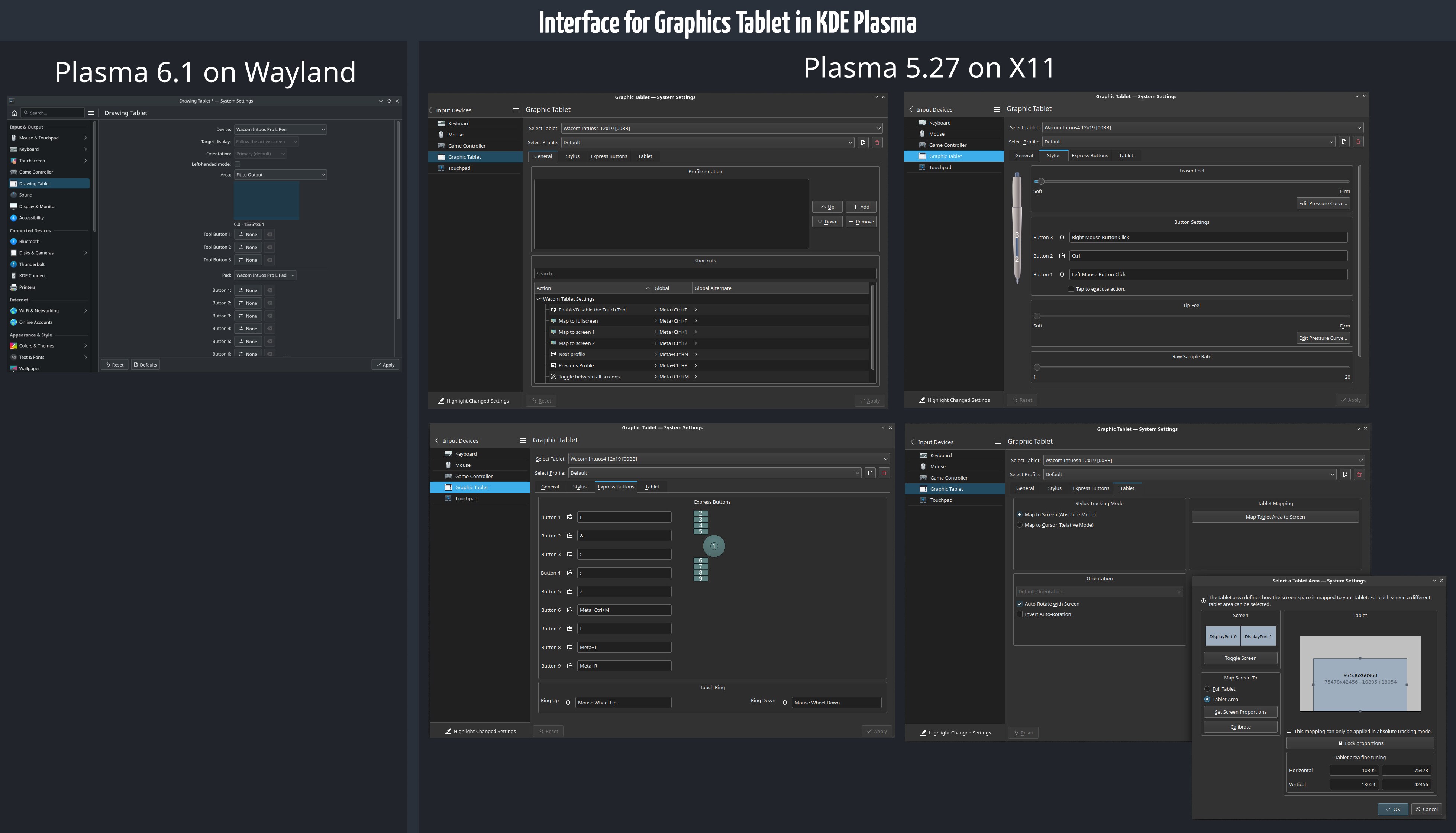
some people like professional artists and users that handle external devices like digital pens seems to still prefer X11 over Wayland due to available support.
My 2 cents think: considering there still is this necessity I would prefer to still have the possibility to chose X11 or Wayland, because the migration of all those functionalities from X11 to Wayland are ongoing and they’ll require sometime to be completed.
I wasn’t amused to discover AFTER updating via octopi that i was forced into wayland and some of my NEEDED apps (e.g. moneymanagerex) were no longer working / crashing.
Then i had to research the issue and had to install plasma-x11-sessions to get my apps back to work.
I’m happy that there was a solution, but i’d very much preferred to receive a warning or an opt-out beforehand …
If you are a gamer and want HDR, Wayland is the only way to go. X11 will not get HDR plus X11 not secure like Wayland. I always chuckle and grab the popcorn when a Phoronix article pops up about Wayland or X11. Some of the comments are hilarious. There are some die hard users of X11 that refuse to let it go. Wayland is the future and there is a reason why most distros are going full Wayland sooner rather than later.
Nowadays it is not too diffcult to find out, that CachyOS prefers wayland, before you install it.
And you can always install the x11 sessions if you need them.
Imho I am not a fan of apps, that do not invest the necessary work, although the adoption of Wayland is picking up speed and will be the default in many of the main distros ths year.
I’ve been exploring the MMEX bug reports via GitHub and wanted to share my broader thoughts about X11 vs Wayland.
Personally, I still use X11 — not because I’m against Wayland, but because many of the features I rely on simply aren’t there yet. For example, creating a transparent, click-through, always-on-top overlay like this one was far more painful on Wayland. Global hotkeys were another hurdle. While I eventually managed to port my overlay to Wayland using about 10MB of custom shellcode and heavy patching, the default experience was far from ideal.
I also spent a few hours trying to get RDP working from Windows to Linux while running Wayland. While I’m sure it’s possible with enough effort, it quickly became more trouble than it was worth. At that point, I just didn’t feel like wrestling with Wayland any further.
I’m aware there are other remote desktop options out there, but for my needs, RDP remains the most practical and seamless solution—especially when connecting from Windows.
That said, I recognize that Wayland is the future. The more it’s used, the better it will become. But at this moment, for my workflow and experiments, X11 is simply more practical.
On KDE6 + X11
My experience with KDE6 on X11 has been disappointing. Despite having a capable system (i9-9900K, 2080 Ti, 32GB RAM), desktop animations were choppy across Bazzite, Garuda, and CachyOS. I suspect KDE is now focusing more on optimizing for Wayland.
Fortunately, I use Compiz as my window manager — with Emerald and full effects — and that combo works flawlessly. Smooth as butter. If you’re into visual polish and performance, Compiz on X11 is still an unmatched experience.
If anyone’s interested, I regularly create installable ISOs after major kernel or system changes. My image includes tweaks like:
ptrace disabled for non-sudo users
CPU timing spoof (RDTSC)
KVM detection fixes for games like Valorant, Tarkov, and R6
WMI and sensor emulation inside the VM
I’ve tested it extensively and can share the ISO if anyone wants to try it.
Final thoughts
I know it’s a bit niche, but I truly only use Linux because Compiz exists. It’s my fun box. If Compiz were gone, I’d honestly just stick to Windows — not because Linux is bad, but because I find little that’s uniquely compelling outside of that for my use case.
That said, CachyOS has been the best distro I’ve tried so far. The only minor gripe: it defaults to Wayland and doesn’t preinstall X11 out of the box. Still, it’s an outstanding distro with great performance and polish.
While it may not be worked anymore, XLibre is, in fact, being made. I hope y’all can consider it sometime in the future if X is still an option in the future.
I’d be happy to test that out, as I personally prefer X over Wayland (as Wayland’s broken by design, and probably will be that way for a long time).
X11 is fundamentally broken from a technical and security standpoint and that probably isnt going to change.
xlibre or x11libre or whatever they end up calling themselves if they actually have any sustainability at all .. is mostly, for the moment, political theatre.
But to the extent it functions as a honey-trap for folks who like to trade queer-bashing memes instead of them polluting the ‘regular’ development channels it may actually be a good thing.
Ditto for unsavory characters having all the more vulnerable systems.
I have been using wayland for the past few months. I’m giving X11 another shot due to better nvidia support, supported apps, & browsers not crashing. It’s too bad there isn’t better compatibility, standard development targets, & better global options with Wayland. Tbh, it takes time to follow the 2 different projects. I’m already hoping there would be a 3rd option that takes the best of both worlds.
X11 is fundamentally broken from a technical and security standpoint and that probably isnt going to change.
Seems like both are broken right now
Dropping this here. It all it depends…Maybe Wayland can up it’s game to give less reasons to keep on using X11. I’ll probably end up using Wayland again…but the reasons to use X11 are also compelling.
I dont think adding more flame/propaganda to the mix here is what was needed.
Did you sign up just to post it? Do you use Cachy?
I see lots of politics and maybe even a larger share of ignorance/confusion at that gist .. one wonders whether its actually as obtuse as it comes off or if it is intentionally skirting the concepts.
These 2 points should give anyone listening to these pundits some pause.
It is indicative of them lacking even basic common sense when it comes to best practices on Desktop Linux as well as the ease with which they will hand-wave whole sections of their ‘argumentation’.
I agree with you. Both are currently receiving active development and it’s good to have options. There doesn’t seem to be anything stopping XLibre from continuing to improve. It’s still new and I’m paying attention to see how it develops, it may surprise a lot of people. Only time will tell.
I’ve been watching their Github page and I haven’t seen any bad behavior. They don’t discriminate against anyone that wants to contribute. The same can’t be said for several other projects.