As a new user to CachyOS, I'm overwhelmed with the options for package installation. Do we really need three different GUI wrappers, or am I just missing something?

I’ll start by saying that, yes, i have read the guide for new users

I can handle pacman just fine, I know the best practices of dealing with AUR packages and all that yazz. But this just because I know how to do something, doesn’t mean I shouldn’t be allowed to enjoy doing things the easy way.

let’s imagine I’m your grandma and I have just booted to CachyOS after an easy and pleasant user experience. My first intuition to look for from the search menu would be “software” ,“program” or “package”. First two work quite nicely, but i’m getting two results, shelly and some other nameless application that also installs software?
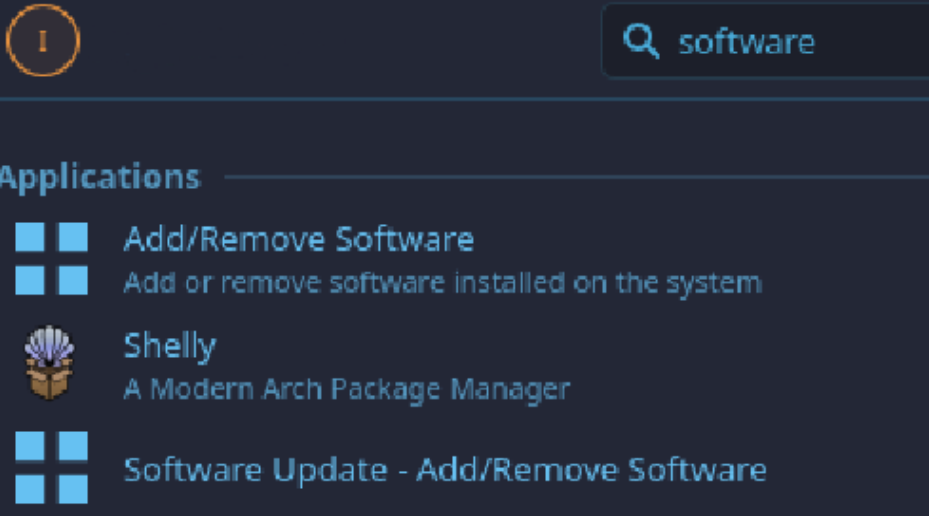
Well, turns out this nameless software is Pamac as the about tab tells me. Then i also note I have a third option, it seems more official. After all, it’s called CachyOS Package installer:

So, at the end of the day, I’m left with these three:
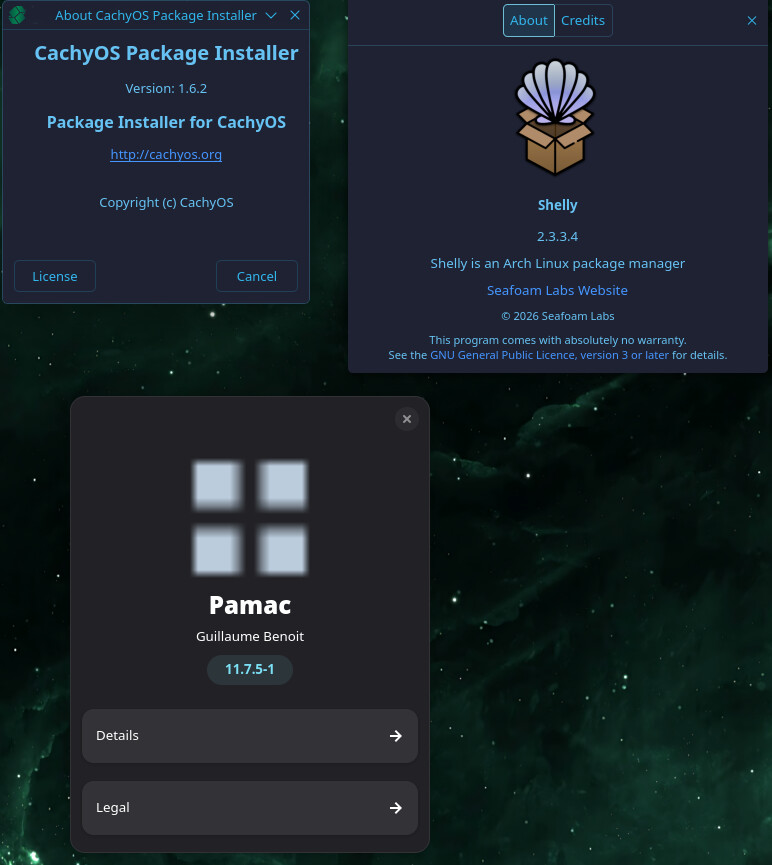
At that point, what exactly am I supposed to infer?

Which one is the recommended one?
Which one is the official one?
Which one is safe for a beginner?
Which one handles normal repository packages?
Which one handles AUR packages?
Which one handles Flatpak?
Which one handles AppImages?
Which one should I use to uninstall something?
Which one should I use to install something?
Which one should I use for updates?
Which one is still maintained?
Which one is CachyOS-specific?
Which one is inherited from elsewhere?
Which one is just a convenience frontend?
Which one is the actual intended “software center” experience?
Why does one of them not clearly identify itself in the launcher?
Why does “CachyOS Package Installer” exist separately from Shelly if Shelly already seems to aggregate many package sources?
Why is Pamac installed or exposed at all if it is not the recommended frontend?
If all three are valid, what is the intended relationship between them?
If one of them is preferred, why is that not obvious from the UI?
If one of them is only for curated installs, why is that not clearly stated in the visible name or description?
If one of them is not recommended for new users, why is it shown next to the others without context?

This is not a problem of “I don’t know how to use pacman”. I can use pacman. The problem is that the graphical experience presents multiple overlapping answers to the same beginner-level question: “Where do I install and remove software?”

From a new user’s perspective, this looks less like flexibility and more like accidental complexity. A beginner does not know which parts are Arch conventions, which parts are CachyOS-specific, which parts are legacy, and which parts are preferred by the CachyOS developers.

If there is truly a reason for doing it like this, then should we not at least inform new users about these three and their relationship/use cases?

PS: fuzzy search is nice, but if i search something from krunner, the result that has the substring in the name or visible short description should always be first anyway. So, why isn’t “CachyOS package installer” the first result, if i search for “software” as can be seen in the first image.

I guess right out of the gate we can chisel those 3 different package management interfaces down to 2. Since Pamac is not only not installed by CachyOS but specifically warned against using.

Now, as for why we need both Shelly and CachyOS Package Installer, I can only say that we do not. Ideally, we’d just want one and it seems like Shelly is the choice CachyOS has made but has forgotten to do away with the other.

I could swear I have not installed pamac myself. How might I check this? Probably installation date

/var/log/pacman.log

so ignore the GUIs which are mostly for other people.

Granny ain’t maintaining a rolling release arch derivative lol.

Funnily, I don’t even use Shelly or CachyOS Package installer. (Pamac isn’t installed by default so it doesn’t matter), I use Octopi when I want to use a GUI package installer, I don’t use Snaps or flatpaks, and because I only use a few appimages I don’t feel I need a package manager to handle them.

I think you’re over-thinking this. Who cares if they include more than one, if a user wants to find out more, they can consult the wiki-and they should consult the wiki before they install, and lastly you can always uninstall what you don’t want.

Also I think you’re underestimating the intelligence and experience of grandma’s, I don’t doubt that plenty of them have been using computers for longer than you’ve been alive.

Check your inxi output. If you have Pamac installed, you’ll see it under Packages… Tools.
Something like this:

Packages: pm: pacman pkgs: 1545 libs: 364 tools: pacseek,paru

Arch is the major distro family that is tied most closely to its CLI package management tool and relies on an informed user to perform certain management tasks manually. ALL of the known GUIs except Octopi (which is just a wrapper around pacman) occasionally break or do weird things.

GUIs are fine and good if you need them but on Arch derivatives in particular the CLI tool is more reliable. So if one is comfortable with it they should generally use it.

Likewise, as a close Arch derivative there’s a liklihood of encountering minor issues including unbootable system, broken internet connectivity, etc. at some point which will require manual intervention.

It’s not difficult intervention, but it’s expected.

That’s just not the right computing experience for a stereotyped “granny” user who is derailed by seeing 2 package management tools. Cachy does a great job with onboarding into a smooth out of the box experience but the user/maintainer is still tasked with maintaining Arch.

Yeah, just after posting I did notice that I have installed it at some point and then just forgotten about that while getting myself familiar with cachy. So, my mistake on that.

And I know I can uninstall what I don’t need. I have used windows… The question was specifically about seemingly unnecessary redundancy as has been addressed before. Pamac is ruled out, so why the need for CachyOS package installer?

And regarding the grandma point, you must realize I only mentioned that to illustrate my point about how this redundancy is confusing?

Shelly is a new arrival, still shaking out. I’m sure either it or the other will soon be departing.
For my part, I think gui installers are evil in Arch.

Ehh… I can enjoy and use both. It’s not the end of the world.

Just because I can drive a manual, doesn’t mean I’m not allowed to enjoy an automatic.

It’s an older tool that isn’t quite a general-purpose software management tool. It mostly just suggests and offers a convenient path to install some mildly curated/recommended packages. That’s why it opens to “manage popular packages”.

It’s likely “still” in the OS for 2 reasons

  1. It’s an in-house semi-legacy tool
  2. It offers that mild curation.

I guess I feel like if your example user to make a point is someone who should probably use a different user it’s best to make that point differently.

It’s no secret why they’re included. Legacy+curation vs. newer and more comprehensive

There is one centralized source of truth. The alpm/pacman database. All of these tools use it. Shelly adds additional access to the unvetted AUR. And if you use flatpaks add the flatpack database as a second source to truth in parallel. This is true whether you manage them from GUI or CLI.

A GUI is not a source of truth

I would have just said I find it confusing rather than using a tired old cliché.

Finally, now was that really so hard? All this wasted time when you could have just gone directly to the point, but no you just had to start by being insufferable. You and your pride and you ego.

And you understand English just fine. I know you know I didn’t claim a GUI is the same as the underlying pacman database or whatever you have configured in there. Everyone else here is able to understand just fine, that the point was the confusion that comes from having two options for a gui tool, and for no apparent reason.

You know you understood that, I know you understood that, so why waste so much time and keystrokes to being part of the problem that hinders the adoption of linux?

(And no, I’m not giving you the checkmark for the answer.)

Q:

A:

The point is that these are all interchangeable, but that best practice is probably to use none of them unless it really improves your comfort level with the OS. “Ignore the GUIs” is indeed getting directly to that point.

You choosing to not believe that is a separate matter.

I can’t read your mind and it’s honestly still not clear that you understand: these software all read and write to the same database. There isn’t any “configuration” to make them do otherwise - other than using Shelly for flatpaks and appimages in addition. And Shelly isn’t a source of truth for flatpaks either.

Just use (or don’t) whatever you want. Preferably pacman + paru if you use AUR for greatest reliability.

Note: per the commit referenced below this is likely moving - at least officially - to shelly. It’s up to individuals to decide if they feel shelly has sufficiently stabilized.

pacman -Qi pamac

Maybe also check using the TAB key if you have pamac-GTK or pamac-GTK3.

Learn to use the terminal, it’s the one tool you can trust more than any other :wink:

In any case it looks like the supported answer will converge to “use Shelly”

With the cachy team (vlad) contributing to shelly and it moving to be the bundled and recommended AUR helper it’s becoming more of a first-party tool.